
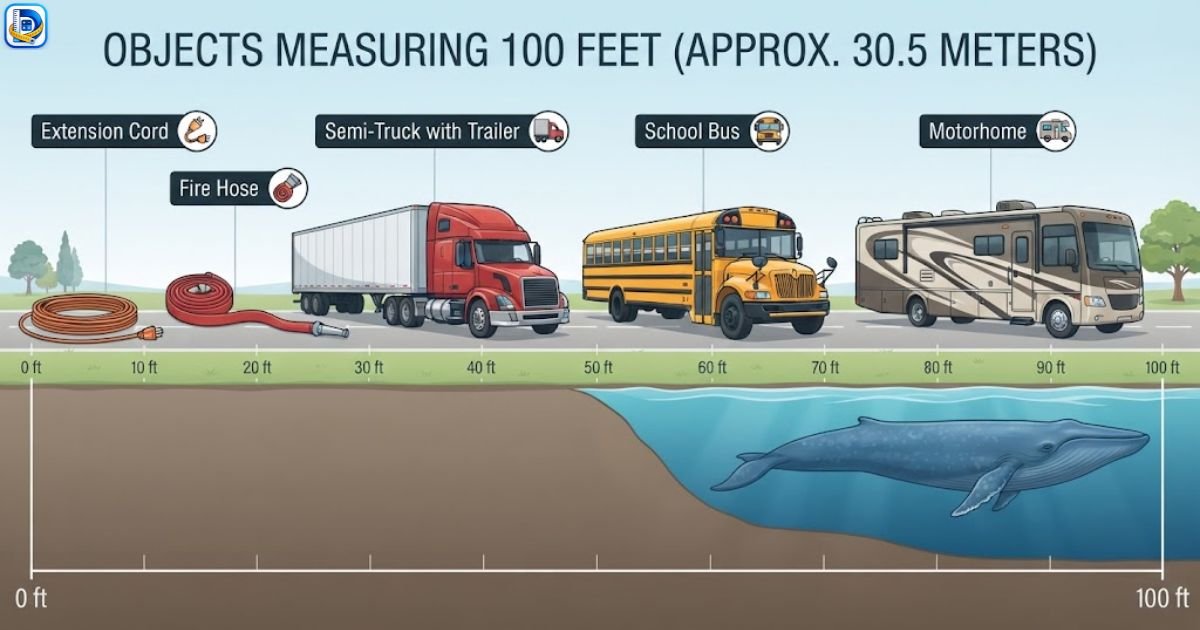
100 feet is a long distance that equals 33.33 yards or 1,200 inches. It can be hard to picture from a number alone. That is why real world examples make 100 feet long much easier to understand.
In this guide you will explore 14 everyday things that are 100 feet long. These examples will help you picture the distance clearly and give you a better sense of how far 100 feet really stretches.
How Big Is 100 Feet?
| Measurement | Equivalent |
|---|---|
| 100 feet | 33.33 yards |
| 100 feet | 1,200 inches |
| 100 feet | 30.48 meters |
| 100 feet | About 0.019 miles |
100 feet is about as long as a third of a football field. It is also close to the height of a 10 story building if you picture the distance upward. Seeing these comparisons makes 100 feet much easier to picture than the number alone.
How Long Is 100 Feet?
100 feet is equal to 1,200 inches, 3,048 centimeters, or 30.48 meters. To picture this distance, imagine walking the length of about 33 average adult steps, lining up several cars end to end, or looking across a space about as long as a basketball court. It is also close to the height of a 10-story building when measured vertically. These comparisons make 100 feet easier to understand without using a ruler or measuring tape.
100 Feet Feels Like
100 feet is a long distance, but familiar spaces make it much easier to picture. It is about 30.48 meters, so you can think of it as the length of several cars parked end to end or a little more than the length of a basketball court.
| Real-Life Comparison | How It Helps You Picture 100 Feet |
|---|---|
| 🏀 Basketball court | A little longer than a standard court |
| 🚗 Cars | About 6 average cars lined up |
| 🚌 School buses | Around 3 buses placed end to end |
| 🏠 10-story building | Roughly similar in vertical height |
| 👣 Walking | Around 33 average adult steps |
| 🏈 Football field | About one-third of the field |
These comparisons show why 100 feet can feel much larger than the number suggests. Whether you are estimating a property distance, room layout, outdoor space, or building height, thinking in terms of familiar objects makes the measurement easier to judge.
Examples of Things That Are 100 Feet Long
When you picture 100 feet in real life it becomes much easier to understand the size. From large vehicles to familiar spaces and structures many things can reach this length. The examples below show what 100 feet looks like in ways you can easily imagine.
Row of 7 Cars
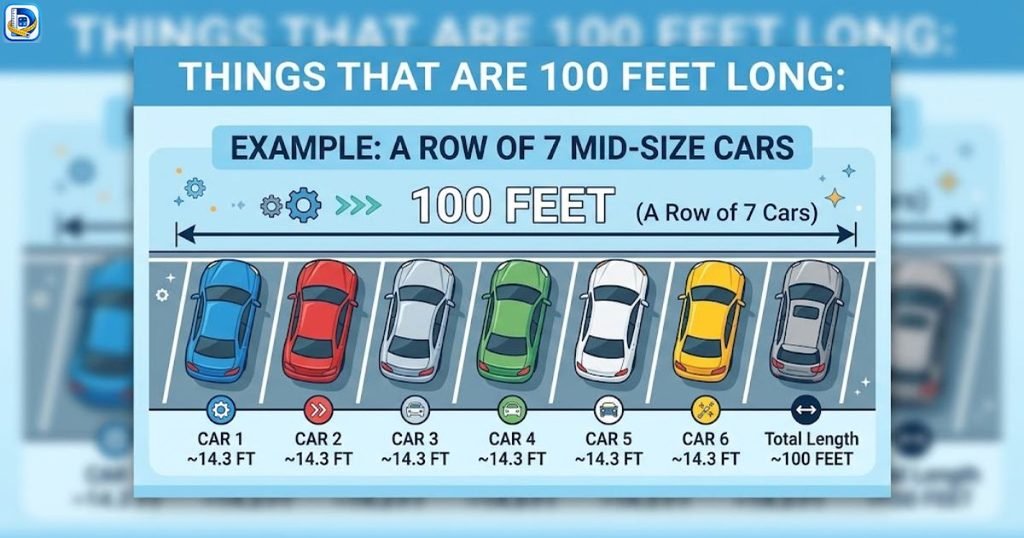
Seven ordinary passenger cars placed bumper to bumper can come surprisingly close to 100 feet. If each vehicle averages around 14 to 15 feet then seven cars would cover roughly 98 to 105 feet depending on the models. That makes a row of seven cars one of the easiest ways to visualize the measurement.
Cars are built in many different shapes and sizes to suit different needs. A small hatchback is designed for efficiency and easy city driving while SUVs provide more passenger and cargo space. Sedans trucks and larger vehicles add even more variety to what you might see on an everyday road.
The first mass-produced automobiles changed everyday life by making personal travel much more accessible. In the United States the Ford Model T became especially important because mass production helped bring automobile ownership within reach of many ordinary families. Today a simple row of cars can still provide a surprisingly effective scale for 100 feet.
Extension Cord
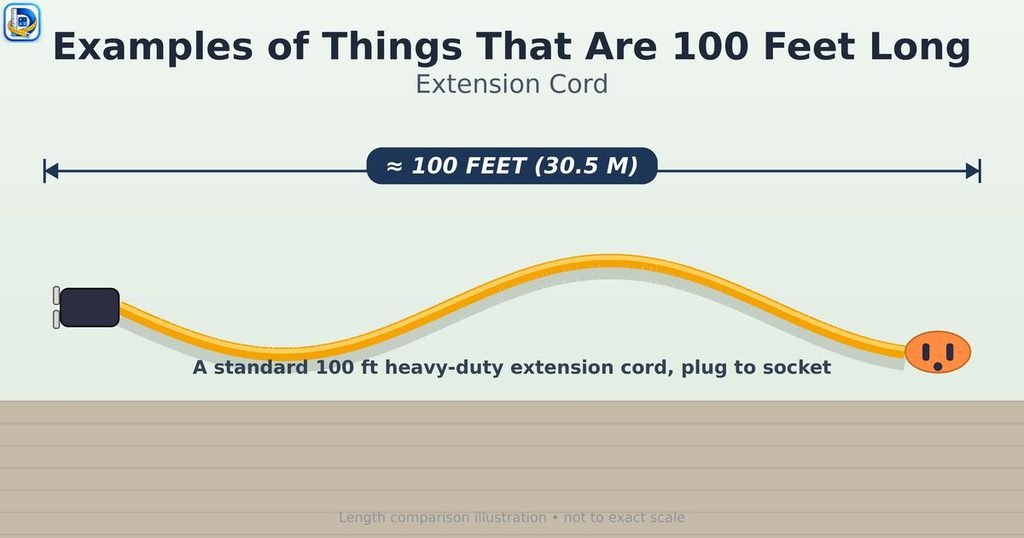
A 100-foot extension cord provides an almost exact visual reference for 100 feet. When fully extended it covers 1,200 inches or about 30.48 meters. Seeing the entire cord stretched across an open area makes it easier to understand the distance from one end to the other.
An extension cord allows electrical equipment to be used farther from a permanent outlet. People use them for temporary power during outdoor projects home repairs decorating and yard work. They normally contain insulated wiring with a plug at one end and one or more outlets at the other.
Long extension cords became particularly useful as electric tools and household equipment became more common. Instead of installing a new outlet every time electricity was needed somewhere else people could temporarily extend the reach of an existing power source.
Fire Hose
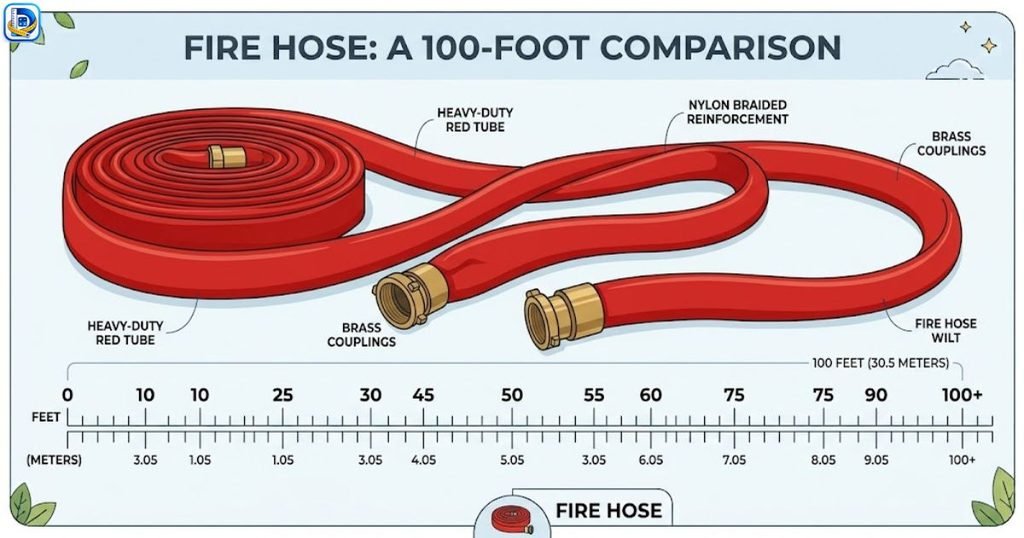
A 100-foot fire hose is another direct example of the measurement. One fully extended hose covers 100 feet which equals 1,200 inches or about 30.48 meters. Because fire hose is usually handled in sections this gives you a practical way to imagine the distance firefighters may need to cover.
Fire hoses are built to move water under pressure during firefighting. They have strong outer jackets and fittings that allow firefighters to connect them to hydrants pumps or other hose sections. Their flexibility also allows them to be carried and positioned around buildings.
Fire hoses have been part of organized firefighting for centuries. Early firefighters used leather hoses before stronger materials and improved manufacturing made modern hose designs possible. The familiar rolled hose seen at fire stations is therefore the result of a long history of firefighting development.
Blue Whale
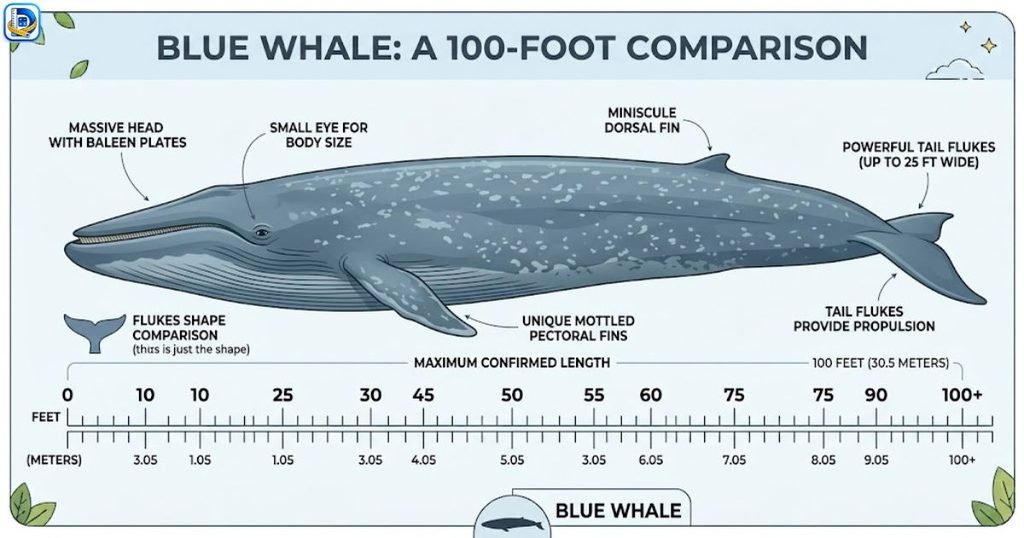
The blue whale is one of the closest natural comparisons to 100 feet because some can reach about 100 feet in length. That is roughly 30 meters or 1,200 inches. Imagine the animal stretched from head to tail and you get an extraordinary sense of how long 100 feet can be. If one blue whale is 100 feet long, three blue whales would be 300 feet long.
Blue whales are marine mammals with enormous streamlined bodies. Despite their incredible size they mainly feed on tiny krill by filtering large amounts of seawater through their baleen plates. Their powerful tails help them travel through the ocean while their blowholes allow them to breathe at the surface.
The blue whale is not simply one of the largest animals alive today. It is considered the largest animal known to have ever existed. Some individuals can reach around 100 feet which makes this creature a remarkable natural reference for understanding the scale of the measurement.
Semi Truck With Trailer
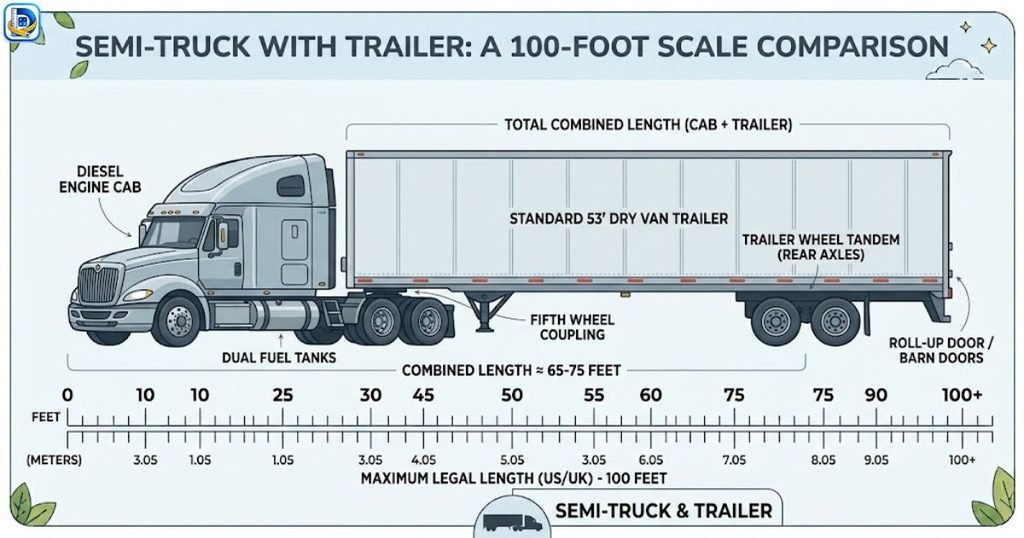
A typical semi truck with its trailer is usually shorter than 100 feet. Many tractor-trailer combinations are around 70 to 80 feet so you would need roughly another 20 to 30 feet to reach the full measurement. That makes a semi useful as a near comparison rather than an exact 100-foot object.
Semi trucks play a major role in moving goods across the United States and other countries. The tractor contains the cab and engine while the trailer carries the freight. This combination allows one driver and one vehicle to transport a large load between distribution centers stores factories and other destinations.
The semi truck configuration also made long-distance freight transport far more practical. Instead of putting the engine and cargo body into one permanent vehicle the tractor can be separated from the trailer. This lets carriers switch trailers and use the same tractor for different loads.
How Long Is 4 Inches? 10 Real-Life Examples
School Bus
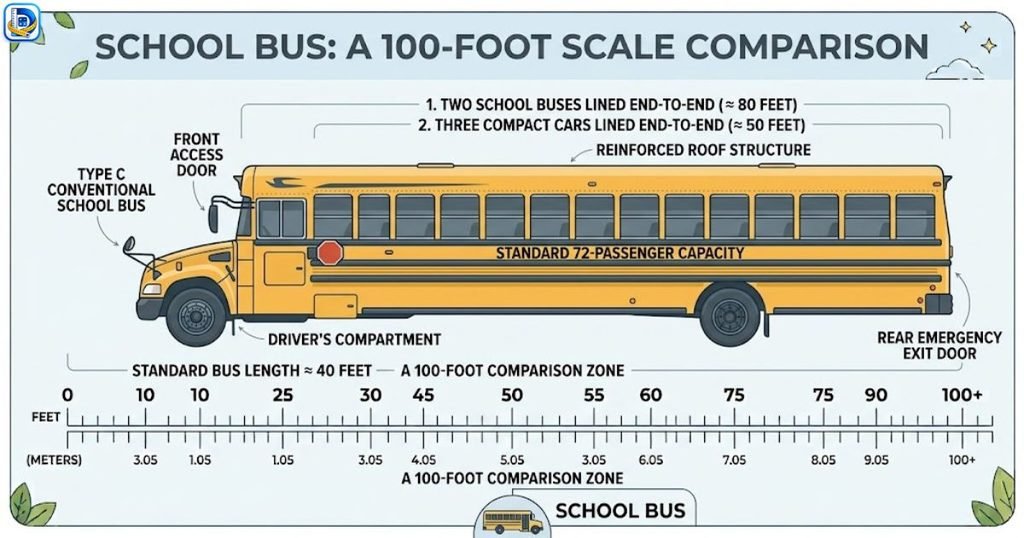
A full-size school bus is generally around 35 to 40 feet long. That means about two and a half buses lined up end to end would bring you close to 100 feet. It is therefore a useful comparison for anyone trying to understand how long 100 feet is without using a measuring tape.
School buses are specially designed to transport large groups of students. Their high seating capacity strong body construction warning lights and stop arms help them operate in busy residential and school areas. The familiar yellow appearance also makes them easy for other road users to recognize.
The yellow school bus has become an iconic part of American transportation. The color was standardized during a 1939 conference that brought educators transportation officials and manufacturers together to develop more consistent school bus designs. That familiar yellow vehicle has been helping generations of students get to school ever since.
Motorhome
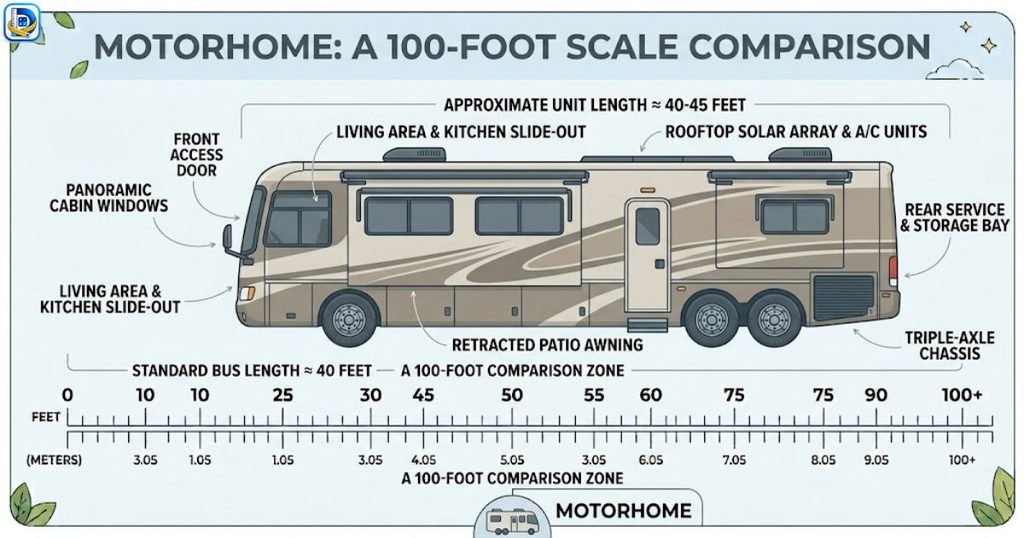
A large motorhome can be around 40 to 45 feet long so one is well short of 100 feet. Two large motorhomes placed end to end could approach 90 feet with another short section needed to reach 100 feet. This makes them a useful everyday comparison rather than an exact match.
A motorhome combines transportation with living space. Larger models can include beds kitchens bathrooms dining areas storage and comfortable seating. They are commonly used for road trips camping extended holidays and traveling between different destinations without relying on hotels.
The idea of traveling with a home on wheels is much older than modern luxury motorhomes. Early recreational vehicles were relatively simple compared with today’s models. Modern motorhomes can contain many of the conveniences found inside a house which explains why some are built more like compact apartments than ordinary vehicles.
Large Yacht
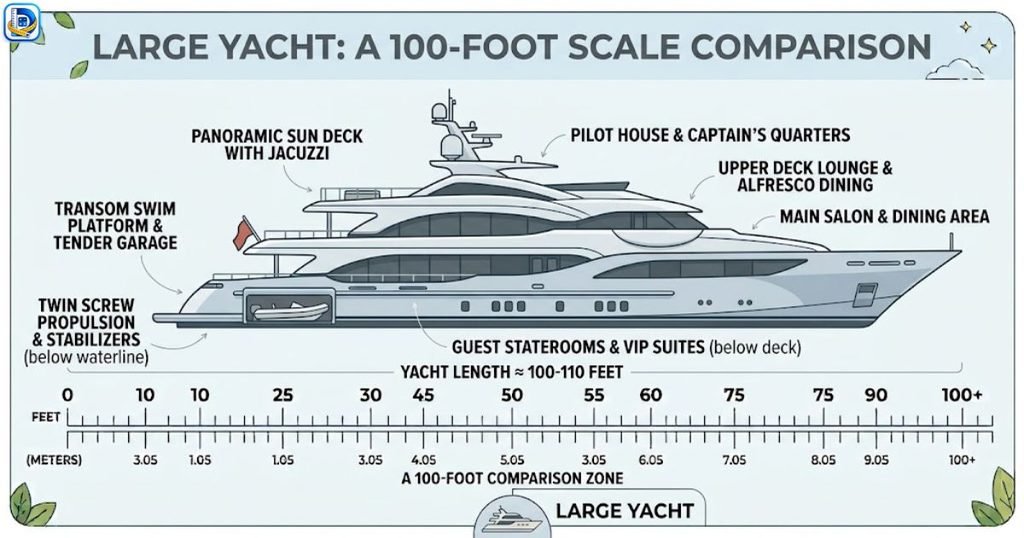
A yacht measuring 100 feet from bow to stern gives you a direct picture of 100 feet. The distance is about 30.48 meters or 1,200 inches. Standing beside a vessel of this size can make the measurement feel very different from simply reading “100 feet” on a page.
Large yachts are designed for comfort and extended time on the water. Depending on the vessel they may include sleeping cabins dining areas lounges kitchens outdoor decks crew spaces and navigation equipment. They can be used for private cruising entertainment fishing or charter trips.
Yachts have a long connection with wealthy travelers and maritime culture. In modern times the word superyacht is often used for exceptionally large luxury yachts. These vessels can include features that would seem unusual on an ordinary boat such as multiple decks swimming areas and elaborate entertainment spaces.
Train Locomotive
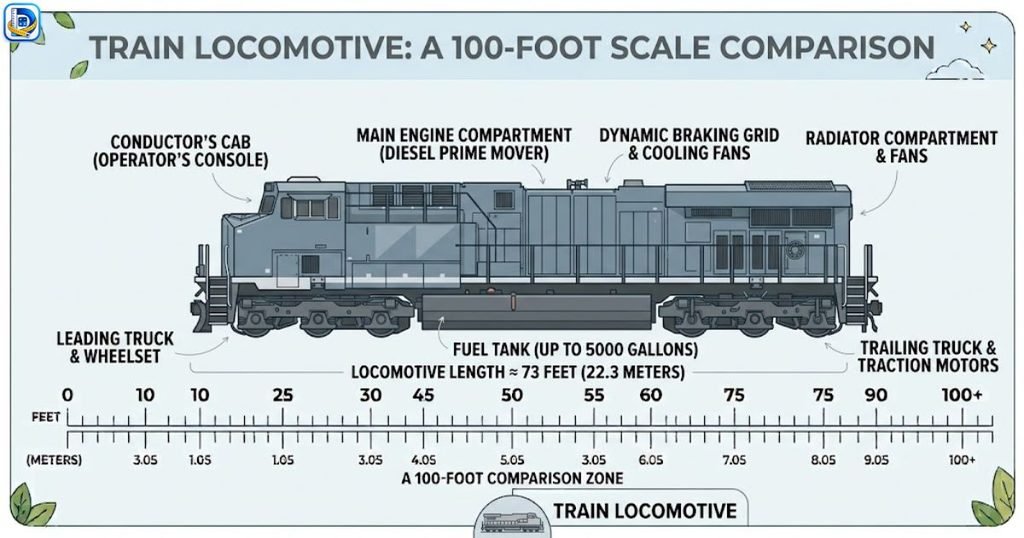
Many large train locomotives are shorter than 100 feet with some falling around the 70 to 80-foot range. Picture a locomotive followed by another 20 to 30 feet of railway equipment and you have a useful representation of 100 feet. The exact size varies considerably by locomotive model.
A locomotive provides the pulling power for a train. Modern locomotives in North America are commonly diesel-electric which means a diesel engine generates electricity that powers electric traction motors. Their enormous pulling ability allows them to move heavy freight or long passenger trains.
The locomotive has a fascinating connection with the Industrial Revolution. Early steam locomotives helped transform land transportation by allowing people and goods to travel much farther and faster than traditional horse-drawn vehicles. Today’s locomotives may look very different but they still perform the basic job of providing power for rail travel.
Row of 10 Parking Spaces
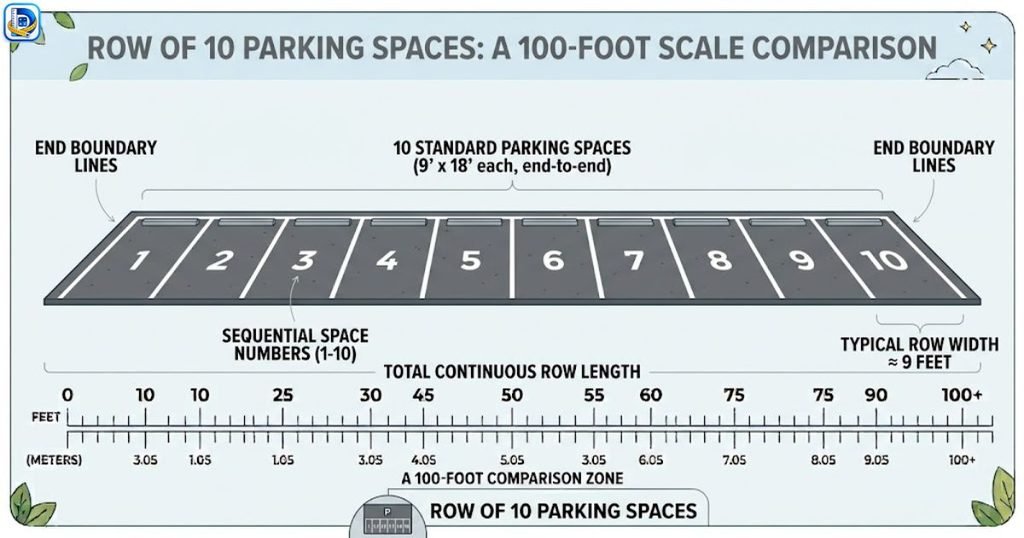
Ten standard parking spaces are actually much longer than 100 feet when placed end to end. A typical parking space may be around 18 to 20 feet long so ten spaces could cover roughly 180 to 200 feet. For a closer 100-foot comparison think of about five spaces plus half of another.
Parking spaces organize vehicles so drivers can leave enough room for nearby cars and access routes. They appear in shopping centers office buildings schools airports apartment complexes and roadside parking areas. Lines and markings help drivers understand exactly where each vehicle should be positioned.
Parking meters also have a surprisingly long history. The first coin-operated parking meter was installed in Oklahoma City in 1935 after the city struggled with increasing demand for limited street parking. What now looks like an ordinary part of a parking area began as an attempt to manage crowded city streets.
Two Basketball Courts End to End
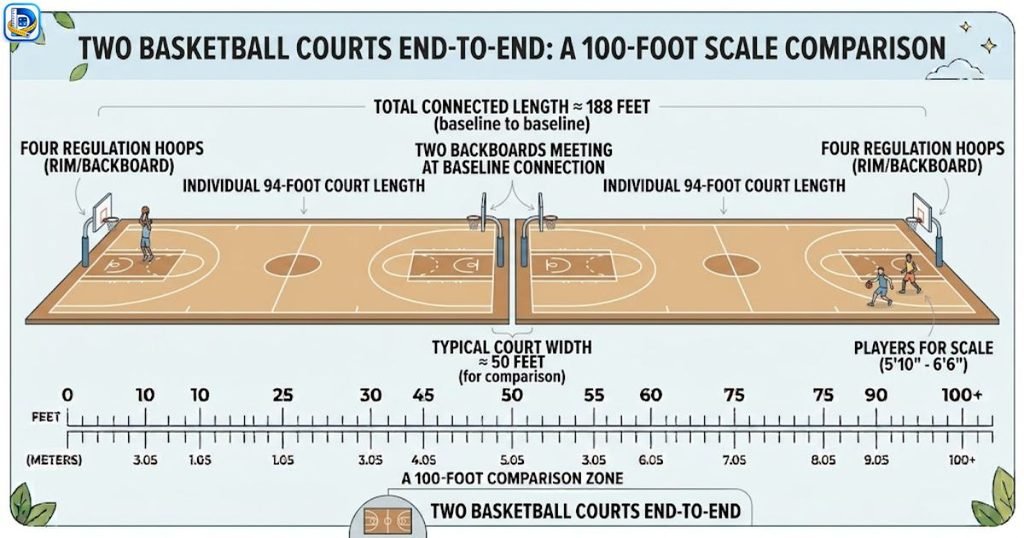
Two NBA basketball courts would actually be much longer than 100 feet. An NBA court is 94 feet long so two placed end to end would reach 188 feet. To picture 100 feet more accurately imagine one complete NBA court and then another 6 feet beyond its baseline.
A basketball court is carefully marked for different parts of the game. It includes two baskets one at each end along with boundary lines a center line free-throw areas and the three-point arc. Players use these markings to understand positions and scoring zones during a game.
Basketball was invented by James Naismith in 1891 as an indoor game for students during the winter. The original game used a peach basket as the goal. The sport eventually developed into the professional game played today which makes a modern basketball court a useful connection between everyday recreation and sports history.
Three Tennis Courts End to End
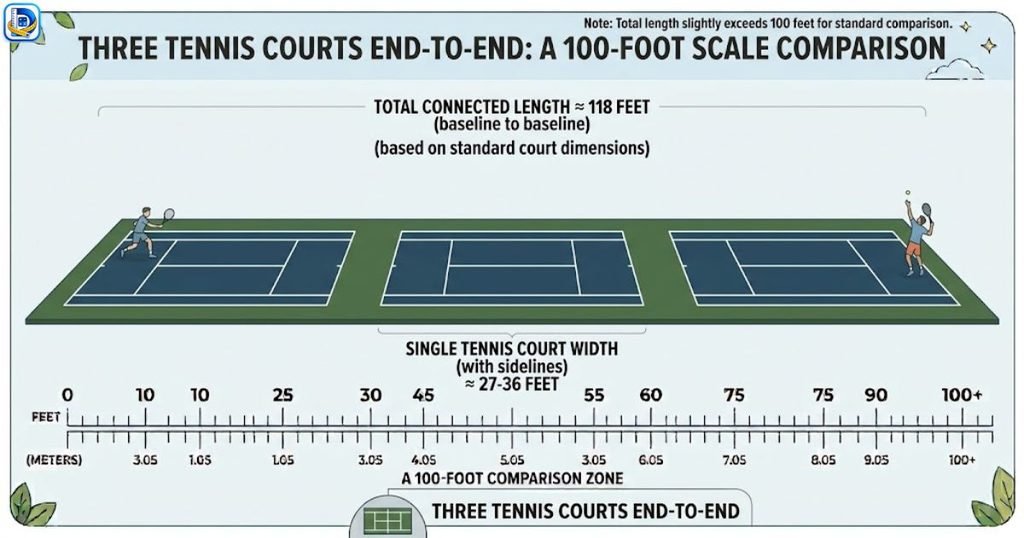
Three standard tennis courts would be far longer than 100 feet. Each court is 78 feet long so three courts would cover about 234 feet. A better way to visualize 100 feet is to imagine one complete tennis court followed by another 22 feet.
A tennis court is a carefully marked rectangular playing area divided by a net. It contains baselines service lines and sidelines that define where the ball can land during singles and doubles play. The court’s layout allows players to move quickly between the baseline and net while keeping the game organized.
Modern tennis developed from older racket games played in Europe. The sport eventually became standardized enough for international competition with Wimbledon holding its first championships in 1877. The familiar court used today therefore represents a much longer sporting history than its simple lines and net might suggest.
A 10 Story Building
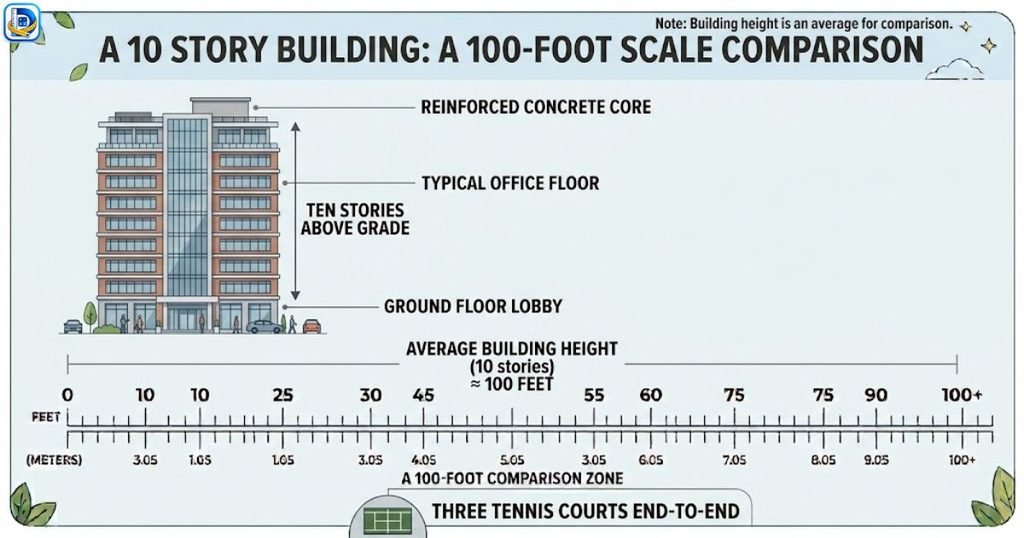
A 10-story building can help you picture 100 feet vertically rather than horizontally. The exact height varies because floors are not all the same height but a building around ten stories can give you a useful sense of the scale. It is best treated as an approximate height comparison rather than an exact 100-foot measurement.
A multi-story building makes efficient use of limited land by stacking usable spaces above one another. Depending on its purpose a ten-story building might contain apartments offices hotel rooms or a mixture of businesses. Stairs elevators windows and structural columns all work together to make those multiple levels practical.
One of the most famous milestones in tall-building history was the Home Insurance Building in Chicago. Completed in 1885 it originally stood 10 stories and reached 138 feet. Its steel-frame design helped demonstrate how buildings could rise much higher without relying on extremely thick load-bearing walls.
Conclusion
Seeing 100 feet long through familiar objects makes the measurement much easier to grasp. A garden hose can show the full distance while several cars or school buses give you a sense of scale. Once you connect how long is 100 feet with things you already see around you the number stops feeling abstract.
The next time you hear a measurement like this do not picture the number alone. Think about a row of cars a long hose or the stretch of a sports court. That simple habit can make 100 feet in meters and other unfamiliar measurements much easier to understand and remember.
I shared the most useful real-life comparisons to help you understand this measurement without relying on numbers alone.
Bookmark this website for future guides on measurements conversions feet inches meters and everyday size references.
FAQ’s
How long is 100 feet visually?
100 feet looks like a long distance, roughly the length of several cars lined up together.
What is about 100 feet long?
Three school buses lined up end to end are roughly 100 feet long.
What does 100 feet look like?
100 feet looks similar to a basketball court length, several cars, or about 33 walking steps.
Is a football field 100 feet long?
No, an American football field is 360 feet long, so 100 feet is much shorter.
What is 100 feet comparable to?
100 feet is comparable to three school buses, six cars, or roughly one-third of a football field.
How many car lengths is 100 feet?
100 feet is roughly six average car lengths, depending on the size of each car.
2 thoughts on “14 Real Things That Are About 100 feet long”