

300 feet is a long distance that equals 3,600 inches or about 91.4 meters. It can be hard to picture from a number alone. Common life examples make this measurement much easy to understand.
Stop where you are and look at the things listed below. Think about them for a moment, and you may already know how far 300 feet is 😊
At first glance 300 feet may not sound very far. But once you connect it to familiar places and objects the distance becomes much easier to picture. These simple comparisons can change how you see this measurement.
How Long Is 300 Feet?
300 feet is equal to 100 yards or 91.44 meters. It is also 3,600 inches. While these numbers tell you the exact distance, comparing 300 feet with familiar objects and places makes it much easier to picture in your mind.
| Measurement | Equivalent |
| Feet | 300 feet |
| Inches | 3,600 inches |
| Yards | 100 yards |
| Meters | 91.44 meters |
| Centimeters | 9,144 cm |
What Does 300 Feet Look Like?
300 feet looks like a long stretch of space. It is the same length as a 100-yard football field, about 20 average cars lined up, or roughly 7 to 8 school buses.
If you stood at one end and looked toward the other, the distance would be easy to notice. In height, 300 feet is roughly like a 30-story building, giving you a clear idea of how tall it can look.
13 Real-Life Things That Help You Visualize 300 Feet
Finding something exactly 300 feet long can be difficult in everyday life. The examples below use familiar structures and spaces to help you understand this distance. Some are exact by design while others are useful visual references for imagining the full length.
20 cars
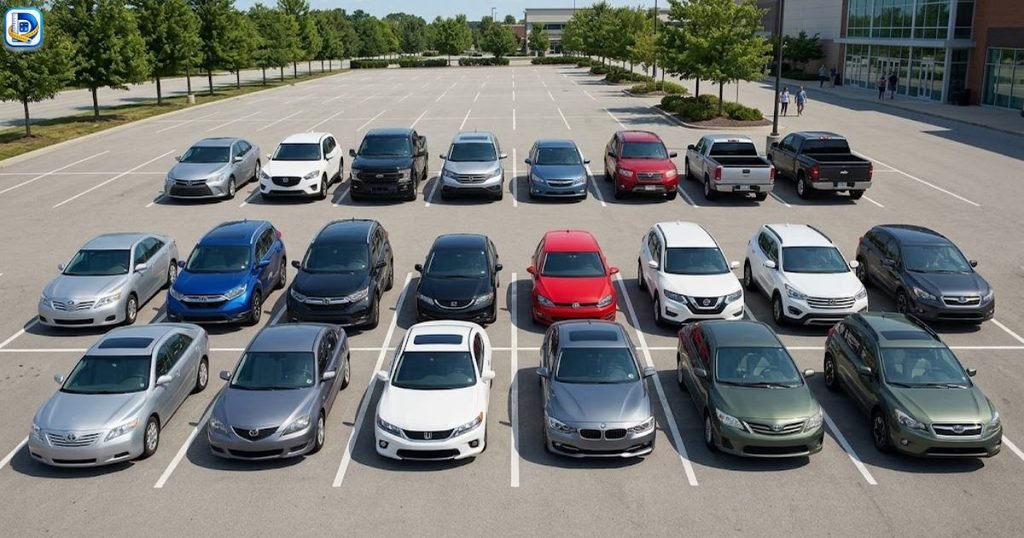
An average car is about 15 feet long. Lining up 20 average cars end to end gives you roughly 300 feet. This makes a long distance like 300 feet much easier to picture than a number alone.
Cars come in many shapes and sizes. Small city cars may be shorter while large SUVs and pickup trucks can stretch well beyond 17 feet. Their length also affects parking space and road room.
The modern car became widely available in the early 1900s as mass production made vehicles more affordable. Today cars vary greatly in size but a row of 20 average cars still gives a useful way to imagine 300 feet.
3 blue whales

A large blue whale can reach around 100 to 110 feet in length. Three very large whales placed end to end could therefore approach or pass 300 feet. It gives this distance a dramatic scale.
Blue whales are the largest animals known to have lived. Their long streamlined bodies help them move through the ocean while their huge mouths allow them to feed on tiny krill.
Blue whales were heavily hunted during the 20th century and their numbers fell sharply. Conservation efforts later helped protect the species. Their enormous size makes them one of the most striking ways to understand 300 feet.
How tall is a Monster can, and what are its dimensions?
state of laberty

The Statue of Liberty stands about 305 feet from the ground to the tip of its torch. That is remarkably close to 300 feet. Standing beside it gives you a strong idea of how high 300 feet really is.
The statue was designed as a giant figure holding a torch above New York Harbor. Its copper exterior has developed the green color that people now instantly recognize.
The Statue of Liberty was dedicated in 1886 after being given to the United States by France. Its height has made it a famous landmark for generations and a useful real world reference for 300 feet.
30-story building

A 30-story building can be close to 300 feet tall when each floor averages around 10 feet. The exact height varies because offices homes and other buildings use different floor heights.
Tall buildings use steel concrete glass and other materials to create strong structures that can handle their own weight and heavy wind loads. Elevators also make these heights practical for everyday use.
Modern skyscraper construction grew rapidly during the late 19th and early 20th centuries. Today a 300-foot building may look impressive but it is far shorter than the world’s tallest skyscrapers.
city block

A city block can be close to 300 feet long in some places. Manhattan street blocks are often around 264 feet from one street to the next. This shows why a typical block can serve as a rough 300-foot reference.
City blocks are shaped by streets buildings sidewalks parking areas and public spaces. Their size changes from one city to another because streets developed under different plans.
Some cities were carefully planned while others grew over many years. That history explains why there is no single standard city block size. A block near 300 feet is therefore best treated as an estimate.
300-foot tree

A tree reaching 300 feet is extremely tall. Coast redwoods can grow beyond 300 feet and some of the tallest known examples reach well above that mark. Looking straight up at one gives a powerful sense of the height.
Coast redwoods have thick trunks strong bark and enormous crowns. Their height helps them reach sunlight above surrounding plants while their wide root systems help support their massive bodies.
Some coast redwoods can live for more than 2,000 years. They have existed in forms related to today’s redwoods for millions of years. A 300-foot redwood is therefore not only tall but also part of a very old natural story.
large ferris wheel

A Ferris wheel around 300 feet tall would rise as high as a large building. Its circular shape also makes the height easy to notice because the top reaches roughly 300 feet above the ground.
Ferris wheels carry passengers in slowly moving cabins around a giant rotating wheel. The cabins provide elevated views while the wheel turns at a controlled pace.
Chicago introduced the first Ferris wheel at the 1893 World’s Columbian Exposition. It stood about 264 feet tall and was designed as a major attraction. That historic wheel shows how close early Ferris wheel engineering came to 300 feet.
mega yacht

A mega yacht around 300 feet long can feel more like a floating building than a normal boat. Walking from one end to the other could cover nearly the same distance as 300 feet.
These large yachts can include bedrooms dining areas swimming pools lounges and outdoor decks. Their size allows designers to create several separate spaces for travel and entertainment.
The world’s largest private yachts have grown far beyond 300 feet. Some modern designs stretch over 500 feet. A 300-foot yacht is therefore huge but sits below the extreme end of today’s yacht sizes.
wind turbine

A modern utility-scale wind turbine can have a hub height close to or above 300 feet. The hub is the point where the blades connect to the main structure so the full blade tip can reach much higher.
Wind turbines use moving blades to capture wind energy and turn it into electricity. Taller turbines can reach stronger and more consistent winds which helps improve energy production.
Wind turbines have changed greatly since early wind machines were used for mechanical work. Modern utility turbines now reach hundreds of feet into the air. A 300-foot height is therefore a useful way to picture their scale.
40 average walking steps

Forty average walking steps do not normally cover 300 feet. A typical step may cover about 2 to 2.5 feet so 40 steps are closer to 80 to 100 feet. Reaching 300 feet usually takes well over 100 steps.
Walking steps depend on height speed and stride length. A taller person often covers more ground with each step while a shorter person may need more steps for the same distance.
People have used walking as a natural way to judge distance for thousands of years. Older measurement systems even included units based on human movement. This makes steps an interesting but less exact reference for 300 feet.
how long does it take to walk 300 feet?
For an average walking speed of about 3 miles per hour 300 feet takes roughly one minute. A faster walker may cover it sooner while a slower pace can take longer.
The actual time depends on walking speed and conditions. Stairs crowds uneven ground and stops can all increase the time needed to cover the distance.
Walking 300 feet is short enough for many everyday trips but long enough to notice the distance. Thinking of it as about one minute of normal walking gives another simple way to understand how far 300 feet is.
how big is 300 feet compared with 100 feet?
300 feet is exactly three times longer than 100 feet. If you imagine three equal sections of 100 feet placed together the full line reaches 300 feet. It is also equal to 100 yards or about 91.4 meters.
A 100-foot distance can already feel large in an open space. Adding two more sections of the same length creates a much greater stretch. This makes the three-to-one relationship easy to remember.
The yard has a long history in English measurement and became widely used in distance measurement. Since 300 feet equals 100 yards this older unit gives another familiar way to describe the same distance.
Conclusion
300 feet becomes much easier to picture when you connect it to things you see every day. From cars and blue whales to tall trees and buildings these examples turn 300 feet from a number into something you can truly imagine.
Next time you wonder how far is 300 feet just look around and compare it with something familiar. Sometimes the best way to understand a measurement is not to calculate it but to see it in your mind.
FAQ’s
How long is 300 feet visually?
300 feet looks like a long stretch, about the length of a football field between goal lines.
What is an example of 300 feet?
A football field between goal lines is a familiar example of a 300-foot distance.
How does 300 feet look like?
300 feet looks like about 20 cars lined up end to end across a long straight distance.
What is 300 feet compared to?
300 feet is comparable to a football field, about 20 cars, or a roughly 30-story building.
How long is 300 feet to walk?
Walking 300 feet usually takes about one minute at a normal walking pace.
How many football fields is 300 feet?
300 feet equals one football field between the goal lines, excluding the end zones.
3 thoughts on “How Long Is 300 Feet? See 13 Real-Life Examples ”